A couple of weeks ago I came across a comment on TMP about molds for some scenics, and it directed me to here. So I picked up mold #93 from this page. Lovely sloped walls - could almost be Chinese! I've started making lots of "bricks" (or rather massive blocks) to make some Martian city walls. The process is a bit fiddly, but I get to revert to childhood and be a bricklayer / lego builder again.
I'll probably make them 3 blocks high to start with (that's 1.5" in old money) plus a parapet (the lotus-pattern bricks with an outward curve). That should be plenty for a provincial town or outpost.
It will probably need a pretty rigid base as I don't think they'll take happily to flexing, but we'll see where it takes me.
If anyone out there has some tips or tricks with using plaster of paris for builds, please let me know!
Wednesday, 7 November 2012

Tuesday, 23 October 2012
Jingals (San-bujaan)
"A jingal or gingall,
(Hindi janjal) is a type of gun, usually a light piece mounted on a swivel; it
sometimes takes the form of a heavy musket fired from a rest."
Here's how I'm making
the "form of a heavy musket fired from a rest" as will be used
by my Martians. As always I'm using the
Black Hat imperial martians.
Raw materials: Figure
firing from shoulder; pavise (from the imperial martian guard pack); a 28mm
martian musket I picked up a while back from Bob Charette's Parroom Station range (two on a sprue); some skin and/or blood*
*optional but
inevitable
Here are the bits I
used:

First I trimmed back the stock and bayonet to make the jingal. I then hacked the musket off the figure, and "carefully" opened up a gap between right arm and body to accept the stock. (That's where the blood donation came in. Again.)
Here's the half-way stage:

One of the two muskets is probably a bit short, so I'll see if it can be used for something else - perhaps an organ-gun or something. It'll go off to the bits box for the moment.
Then assemble, with appropriate filing to fit, and mount on base with two other figures to maintain the 3-infantry-to-a-base ratio:

I'm hoping that the pavise will help to secure and stabilise the figure. I could have attempted a bipod/tripod, but the pavises weren't going to be used for anything else (and you get 8 in a packet for "free" with the Guards), so why sweat it? It looks good, and I even get to use a handgun figure as a loader!
Monday, 22 October 2012
Polearm Infantry
I'm using Black Hat figures for my Martians. It's a nice range; well-detailed and quite diverse. You can find them here.
There are three main types of infantry packs:
- Imperial Martian Guard infantry, with helmets and corselets and musket or polearm,
- Imperial Martians with guns or swords
- Askari with guns or swords
They have good command packs of each of them as well. I'll get to mounted troops later.
So far so good. I'll be using the non-guard troops as the mainstay of the army, and I need a mixture of muskets and pole arms. There are no polearm figures for the non-guard troops, and the packaging of the gun troops poses some problems. Here's a pic of the contents:

As you can see three of the eight in the packet are armed with handguns, and I don't need handguns. However I can use these handgun figures by converting them into polearm figures. A bit of brass wire, a plasticard blade, et voila - here are before/after pictures:

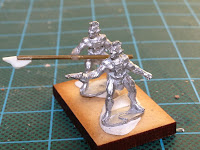

My guns and polearms are in a ratio of about 2:1, so I can use pretty much all of the figures. Being a Scot I hate wasting money on figures I can't use, so I'm glad I can use them pretty effectively.
They rank up pretty well, and hopefully the polearms will be fairly robust. I'll probably replace the alloy polearms on the Imperial Guard figures with wire ones in due course.
Jingalls next - more conversions!
There are three main types of infantry packs:
- Imperial Martian Guard infantry, with helmets and corselets and musket or polearm,
- Imperial Martians with guns or swords
- Askari with guns or swords
They have good command packs of each of them as well. I'll get to mounted troops later.
So far so good. I'll be using the non-guard troops as the mainstay of the army, and I need a mixture of muskets and pole arms. There are no polearm figures for the non-guard troops, and the packaging of the gun troops poses some problems. Here's a pic of the contents:

As you can see three of the eight in the packet are armed with handguns, and I don't need handguns. However I can use these handgun figures by converting them into polearm figures. A bit of brass wire, a plasticard blade, et voila - here are before/after pictures:


My guns and polearms are in a ratio of about 2:1, so I can use pretty much all of the figures. Being a Scot I hate wasting money on figures I can't use, so I'm glad I can use them pretty effectively.
They rank up pretty well, and hopefully the polearms will be fairly robust. I'll probably replace the alloy polearms on the Imperial Guard figures with wire ones in due course.
Jingalls next - more conversions!
Sunday, 21 October 2012
OK, so when you say "100" ...
Call me a boring old accountant, but when I was thinking about unit sizes, I got to thinking about number systems, time and how your average Martian measures things in general.
Number
As everyone knows(?), Martians have four fingers (or three fingers and an opposable thumb if you want to be pedantic) or toes at the end of each appendage. So I can't think of any reason why they would have hit upon a decimal system of counting. As for humans, two handsfull seems to be a good unit of measure (stop sniggering at the back!), so an octal system of numbering would make perfect sense. To the dyscalculic amongst us, that means that Martians count on their fingers as follows: 1, 2, 3, 4, 5, 6, 7, 10, and then 11, 12, 13, 14, 15, 16, 17, 20 after removing shoes and socks.
I can therefore imagine their military units being based on multiples of 8, giving theoretical values as follows:
Somewhat bizarrely, we end up with the nice octal round numbers used by my Martians being the same as appeared in classical Greek tactical manuals! Maybe there really was something extraterrestrial about Altantis after all?
OK that worked out pretty well, and gives comparable unit sizes to terran counterparts.
Next stop ... Calendars and Time. I'm betting the answer is 42, but we'll see.
Real World Footnote:
Apparently the Yuki language in California and the Pamean languages in Mexico use octal number systems because the speakers count using the spaces between their fingers rather than the fingers themselves. Ain't Wikipedia a wonderful thing?
Number
As everyone knows(?), Martians have four fingers (or three fingers and an opposable thumb if you want to be pedantic) or toes at the end of each appendage. So I can't think of any reason why they would have hit upon a decimal system of counting. As for humans, two handsfull seems to be a good unit of measure (stop sniggering at the back!), so an octal system of numbering would make perfect sense. To the dyscalculic amongst us, that means that Martians count on their fingers as follows: 1, 2, 3, 4, 5, 6, 7, 10, and then 11, 12, 13, 14, 15, 16, 17, 20 after removing shoes and socks.
I can therefore imagine their military units being based on multiples of 8, giving theoretical values as follows:
| Octal | Decimal | Macedonian title | |
| Squad | 20 | 16 | Lochos ("file") |
| Platoon | 100 | 64 | Tetriarchia |
| Company | 200 | 128 | Taxis |
| (omitted | 400 | 256 | Syntagma) |
| Battalion | 1000 | 512 | Pentakosiarchia |
| Legion | 4000 | 2048 | Merarchia |
| Army | 10000 | 4096 | Apotome |
Somewhat bizarrely, we end up with the nice octal round numbers used by my Martians being the same as appeared in classical Greek tactical manuals! Maybe there really was something extraterrestrial about Altantis after all?
OK that worked out pretty well, and gives comparable unit sizes to terran counterparts.
Next stop ... Calendars and Time. I'm betting the answer is 42, but we'll see.
Real World Footnote:
Apparently the Yuki language in California and the Pamean languages in Mexico use octal number systems because the speakers count using the spaces between their fingers rather than the fingers themselves. Ain't Wikipedia a wonderful thing?
Translating SC into DoB2
SC (the Soldier's Companion ruleset by GDW, now published by Heliograph) gives a great deal of useful information on building Martian states and armies, and it is as good a starting point as anything for building up scenarios and "consistent" backgrounds for battles and campaigns.
The norm in SC is for units of 20 foot or mounted (including 3 or 4 officer/NCO figures). The implied scale is about 1:10, and the British army has 4 "companies" of 20 figures making a full battalion which confirms this. It also states that "most Martian Regular infantry is armed with smoothbore musket as well as some sort of melee weapon" which somewhat belies the typical 50/50 split of a Martian band between "cutters" and "shooters", but we'll go with the flow. For random cities, the base force strength is 2 bands of infantry, 1 band of mounted and 2 guns per "army number", so your basic building blocks are of 60 figures plus 2 guns.
But as I want to use Piquet's DoB2 (Din of Battle 2) in company scale, I need to do some translation work. Company scale in DoB2 has each infantry unit (12 figures) representing 80-150 men, and an 8-figure mounted unit representing 40-80 men. A gun model (and 3 crew) represents a gun section of 2-3 guns. We're therefore talking about a similar figure/man ratio to that used in SC.
In my "typical" regular Martian unit I have a 4-company battalion consisting of
- 2 companies of infantry armed with muskets
- 1 company of infantry armed with polearms
- 1 company of infantry armed with jingals and rockets
That's 48 figures, and is close enough to the 2 bands of 20 infantry in SC. The 20-figure mounted band will be represented by 2 troops of 8 mounted under DoB2. That's 64 figures in all, so pretty good. And 2 gun models is 2 gun models, as both rules sets have a model representing a gun section.
SC also attaches both mounted and foot mercenary bands to much of the regular forces, again on the 20-figures per band model. I'll therefore have each band represented by two DoB2 units of the relevant type. That's overweight in infantry and underweight in mounted but balances out fairly well. I haven't decided whether I'll split the foot units into one each of "shooters" and "cutters", or whether I'll have them as mixed-weapon units. Splitting will make them more specialised, but also less versatile. They are intended for "light scouting and skirmishing" duties, so versatility would seem to be more appropriate, and it would also help to differentiate them from regulars. Time will tell.
Subscribe to:
Posts (Atom)